
How Jaxson Dart's Knee Injury Changes the Giants' 2026 Season
How Jaxson Dart's Knee Injury Changes the Giants' 2026 Season
The New York Giants entered the 2026 season with Jaxson Dart at the center of their offense and one of the most important young players on their roster.
Two games into the season, that plan has changed dramatically.
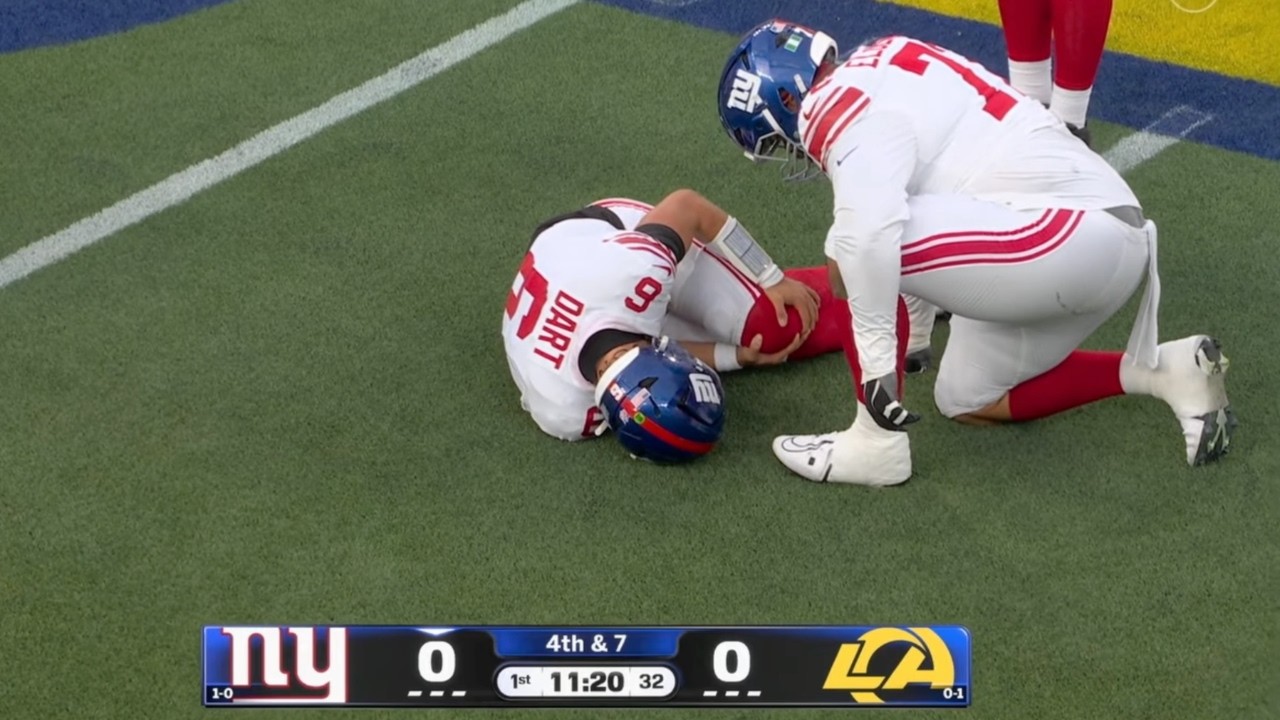
Dart suffered a left knee injury on the Giants' opening drive against the Los Angeles Rams in Week 2 after being hit by two defenders. New York initially had reason for optimism, but further evaluation produced a much more significant outlook.
Head coach John Harbaugh has confirmed that Dart will miss the remainder of the 2026 regular season. The Giants have placed him on injured reserve, and veteran Jameis Winston will take over as the starting quarterback.
The Giants have not publicly detailed every damaged structure in Dart's knee. Multiple reports, however, indicate that the injury involves the MCL, PCL and meniscus, while the ACL remained intact. Surgery is expected as Dart begins a recovery process that could extend through the remainder of the regular season.
For New York, this is bigger than simply replacing one player.
Dart's injury changes the structure of the Giants offense, the way defenses can approach New York, the outlook for several important skill-position players and ultimately the trajectory of the Giants' season.
Dart Had Already Shown Why He Was So Important
The timing of the injury makes it particularly difficult for the Giants because Dart had opened the season by showing exactly why New York viewed him as its franchise quarterback.
In the Giants' Week 1 victory over Dallas, Dart completed 23 of 29 passes for 230 yards and three touchdowns without an interception while adding 54 rushing yards.
He became the first quarterback in NFL history to begin a season with at least three passing touchdowns, 50 rushing yards and a passer rating of 130.
That performance illustrated what makes Dart difficult to replace.
His value isn't limited to traditional dropback passing. Dart can extend plays, escape pressure and create additional offense with his legs. That mobility forces defenses to account for another running threat on nearly every play and gives the Giants options that aren't available with every quarterback.
Removing Dart therefore changes more than the name at the top of the depth chart.
It changes how the offense can function.
Jameis Winston Now Takes Over the Offense
The Giants will turn to Jameis Winston as their starting quarterback.
Winston is one of the NFL's most experienced backups and has started extensively throughout his career, so New York isn't handing the offense to a quarterback who has never been in this situation.
But his playing style is different from Dart's.
Dart's mobility can stress a defense horizontally and vertically. Designed quarterback runs, scrambles and extended plays create additional variables for opposing defensive coordinators.
Winston is much more likely to operate as a traditional pocket passer.
That doesn't necessarily mean the Giants cannot move the football. Winston has demonstrated throughout his career that he is willing to attack defenses downfield and give his receivers opportunities to make plays.
But New York will likely have to generate offense differently.
The first look at that transition wasn't encouraging.
After replacing Dart against Los Angeles, Winston completed 11 of 27 passes for 111 yards with no touchdowns and one interception as the Giants failed to reach the end zone in a 28-6 loss.
One relief appearance doesn't define what Winston will do as the starter, especially when he entered unexpectedly against a strong Rams defense. It does, however, underline how significant the adjustment could be.
The Giants Lose a Major Rushing Element
One of the easiest impacts to overlook is what Dart contributes to the running game.
A mobile quarterback changes the mathematics of defending an offense.
When the quarterback is a legitimate threat to keep the football, the defense has another potential ball carrier to account for. That can create additional space for running backs and make options, read concepts and play-action more difficult to defend.
Dart's 54 rushing yards in Week 1 weren't simply bonus production. They were part of the identity New York could build around him.
With Winston under center, opposing defenses won't have to respect the quarterback run to the same degree.
That could mean the Giants need more production from their conventional rushing attack and offensive line to consistently stay ahead of the chains.
It could also put more responsibility on the passing game to create explosive plays that Dart previously had the ability to create with either his arm or his legs.
Malik Nabers Becomes Even More Important
The quarterback change also affects the players around him, particularly Malik Nabers.
Nabers is the kind of receiver who can make a quarterback's job easier because he can create separation, win contested situations and generate yards after the catch.
That becomes especially important with Winston taking over.
Rather than asking Winston to replicate everything Dart provided, New York can build around the strengths of the players still available.
Getting the football to Nabers quickly and allowing him to create after the catch could become an increasingly important part of the offense.
Nabers also dealt with a shoulder issue during the Rams game, although he returned and has since progressed to full participation in practice ahead of Week 3.
Keeping him healthy becomes even more important while the Giants adjust to life without Dart.
The Margin for Error Just Became Smaller
Quarterback injuries affect almost every part of a football team.
An offense that struggles to sustain drives puts additional pressure on the defense.
Short possessions can create poor field position.
Turnovers can give opponents short fields.
And falling behind can force an offense to become more predictable.
The Giants experienced some of that against the Rams after Dart left the game. Los Angeles eventually outscored New York 28-6, while the Giants failed to score a touchdown.
That doesn't mean every game without Dart will follow the same pattern.
But it demonstrates how quickly the loss of a starting quarterback can affect the broader game script.
New York's defense and special teams may now have a smaller margin for error because the offense has lost one of its most dynamic players.
Week 3 Becomes the First Real Test
The Giants don't have much time to adjust.
New York enters Week 3 at 1-1 and will host the 0-2 Tennessee Titans at MetLife Stadium.
It will be Winston's first start of the season and the Giants' first opportunity to show what their offense looks like when the game plan is built around him from the beginning.
That distinction matters.
Coming into a game unexpectedly after the starter is injured is very different from receiving a full week of first-team practice repetitions, having the offensive game plan built around your skill set and knowing from the start that the offense belongs to you.
The Titans game should therefore give us a much better first indication of how New York intends to compensate for Dart's absence.
Watch for changes in quarterback rushing concepts, play-action usage, passing depth, early-down aggressiveness and the way the Giants try to manufacture touches for their best playmakers.
Dart's Injury Also Changes How the Giants Should Be Evaluated
For anyone researching Giants games, this is the kind of personnel change that should materially affect how previous statistics are interpreted.
A season-long team average can suddenly become misleading when the quarterback responsible for producing that offense is no longer playing.
For example, New York's offensive performance with Dart shouldn't automatically be treated as representative of what the offense will produce with Winston.
The sample needs context.
That means upcoming Giants analysis should place greater weight on factors such as:
- Winston's performance within this specific offense
- changes in play-calling and offensive personnel
- pass protection
- the Giants' ability to establish the run
- Nabers' usage and health
- third-down efficiency
- turnover rate
- explosive passing plays
- how opposing defenses change their approach
As more Winston starts accumulate, the Giants will generate a new body of evidence that becomes increasingly useful.
Until then, there is added uncertainty.
What About a Jaxson Dart Return?
Harbaugh has been specific in saying that Dart will miss the rest of the regular season.
He has not completely ruled out the possibility of Dart returning if the Giants reach the postseason.
That distinction is important, but it shouldn't be interpreted as a guaranteed playoff return.
Recovery from a significant knee injury depends on healing, rehabilitation and how Dart responds after surgery. There is no precise return date at this stage.
For practical purposes, the Giants now have to prepare as though Winston is their quarterback for the remainder of the regular season.
Anything beyond that depends on both Dart's recovery and whether New York is still playing football when the postseason begins.
The Bottom Line
Jaxson Dart's knee injury is one of the most significant developments of the Giants' young season.
New York isn't simply losing its starting quarterback. It is losing a player whose mobility, passing ability and playmaking helped shape the identity of the offense.
Jameis Winston gives the Giants an experienced replacement, but the offense will not function exactly the same way.
The rushing dynamics change. The passing structure may change. The burden on players like Malik Nabers increases. And the margin for error across the rest of the roster becomes smaller.
The Giants are still only two games into the season, and at 1-1 their year is far from decided.
But the version of the 2026 Giants that takes the field from this point forward will be different from the one New York expected to have when the season began.
Week 3 against Tennessee gives us the first opportunity to see just how different.
Sources
- New York Giants — "Jaxson Dart to miss rest of regular season; Jameis Winston to start"
- New York Giants — "Storylines: Jameis Winston takes over for Jaxson Dart"
- New York Giants — Week 3 injury reports and roster transactions
- Reuters — Initial reporting on Dart's left knee injury
- Sports Illustrated — Reporting on Dart's MCL, PCL and meniscus injuries and expected surgery
Information current as of September 25, 2026.
Run your next bet through Statr
Find the next play, check the risk, and back it with stats — before you place it.