
Statr vs Claude: The better tool for checking your bets
Claude is world-class at software development, coding, and logical reasoning, but it isn't connected to live sports feeds or odds. Statr is built specifically for sports bet checks with current stats and zero opinion bias.
Claude (developed by Anthropic) has earned a world-class reputation among developers, engineers, and researchers for coding tasks, complex software architecture, code debugging, and long-form document reasoning. Ask Claude to refactor a React component, explain an intricate backend algorithm, or analyze a technical specification, and it shines. However, when bettors attempt to use Claude as a sports analysis engine, its general-purpose limitations become immediately clear. Here is how Statr and Claude compare when the objective is evaluating a real sports wager.

Statr
Purpose-built bet checks on live sports data, no biased sources, beginner-friendly chat.

Claude
General-purpose AI assistant. General-purpose, not optimized for bet checks.
Statr is built on live sports data, not stale training cutoffs
General-purpose AI models are trained on a snapshot of the internet. Their knowledge has a cutoff, and for fast-moving things like injuries, lineup changes, line movement, and last-night's box scores, a cutoff is a dealbreaker. Statr pulls from up-to-date sports data sources so the matchup context, player stats, and trends you're reading reflect what's actually happening today — not what a model memorized months ago.
Feature-by-feature comparison
Tap any row to expand the detail. A quick look at where Statr and Claude differ.
StatrClaudeNo human-written articles, blogs, or opinion swaying the read
When you ask a general AI about a game, it's often summarizing human-written articles, beat-writer blogs, and opinion pieces. That writing carries bias — favoritism toward big-market teams, narrative-driven hot takes, and personal opinion dressed up as analysis. Statr doesn't lean on biased written sources. It works from the underlying numbers, so the read isn't swayed by whoever wrote the loudest take that week.
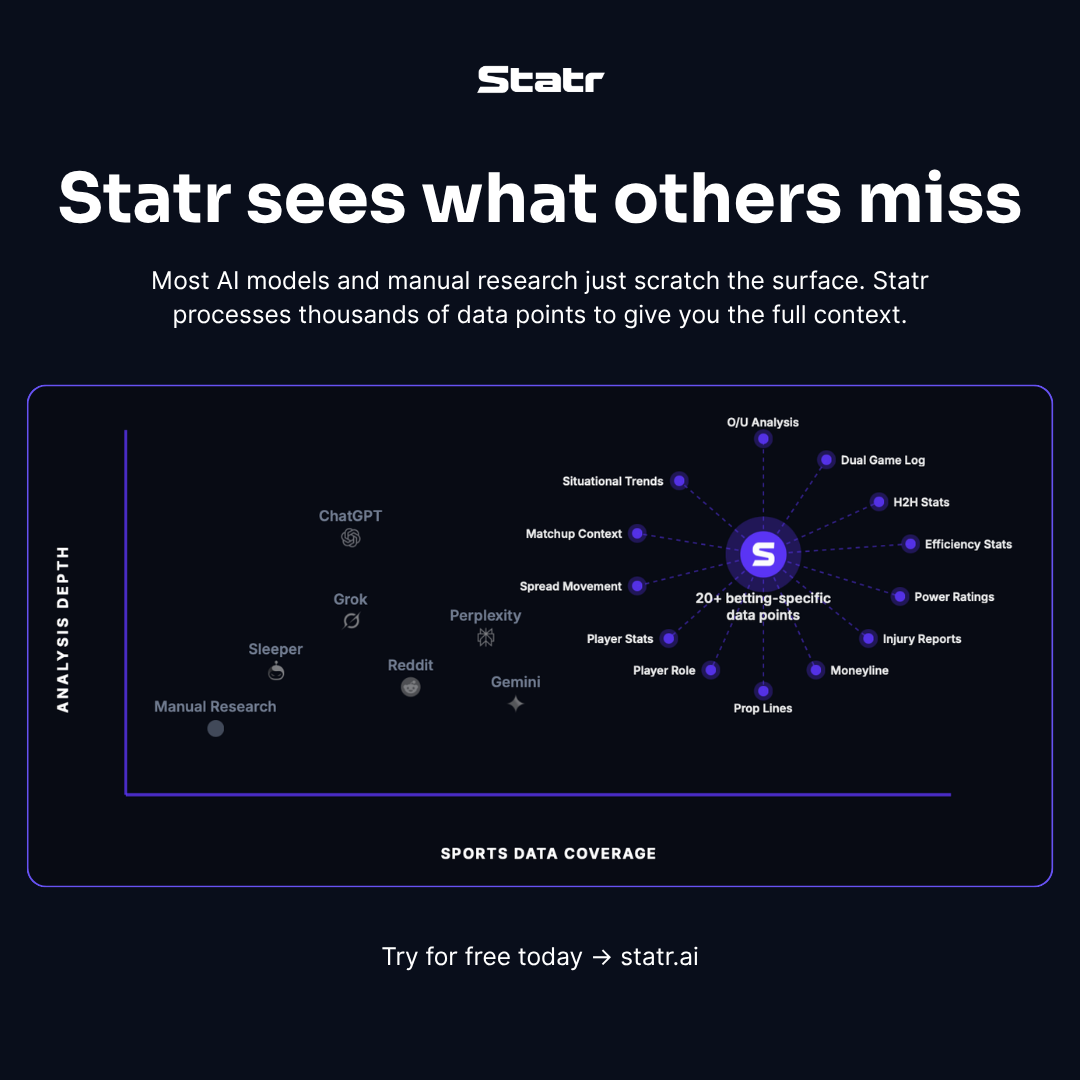
Statr processes 20+ betting-specific data layers live while general AI models rely on general web training.
Built for bettors, not for everything
ChatGPT, Claude, Gemini, and Perplexity are incredible tools, but they're generalists. They can write your resume, debug your code, and plan a vacation — so their sports output is a side feature, not the product. Statr is purpose-built for one job: checking bets. Every screen, prompt, and data source is tuned for sports analysis, which means less prompting, less guesswork, and answers that actually map to the bet you're holding.
Claude excels at coding — not live sports data
Claude's primary superpowers are technical reasoning, code generation, and deep context processing. Developers rely on it daily to write scripts, debug APIs, and analyze technical whitepapers. But software engineering and live sports analysis require fundamentally different data pipelines. Claude lacks direct connections to live sports odds, real-time injury feeds, and tonight's starting lineups. Even its deepest reasoning models can only analyze the sports data you manually copy and paste into the prompt.
- Claude is designed for programming, writing, and analytical reasoning — not real-time sports betting.
- It lacks direct integrations with live odds providers, injury feeds, and matchup statistics.
- Its sports context relies on human-written training articles and static datasets.
- There is no bet-slip image scanning or per-leg risk breakdown — you must format and explain everything yourself.
Statr handles the data so you don't have to prompt
With Statr, you upload a screenshot of your bet slip and the system instantly pulls the necessary live data — matchup history, player props, injury updates, and market movement — then outputs an easy-to-read breakdown of strong and risky legs in plain English. You don't need to write complex prompts or engineer custom system instructions like you would in Claude.
The takeaway
Use Claude when you need to write code, review software, or analyze long technical documents. Use Statr when you need an accurate, unbiased bet check built on live sports data.
Stop guessing. Statr it.
Find the next play, check the risk, and back it with stats — before you place it.