
Statr vs ChatGPT: Which AI is better for sports betting research?
ChatGPT is a brilliant general assistant, but for checking bets it leans on stale training data and human-written articles. Statr is purpose-built for sports analysis with live data and no opinion bias.
ChatGPT changed how people interact with AI, and it's genuinely useful for a thousand different tasks. But when bettors try to use it as a sports analysis tool, they run into the same walls every time: the data is outdated, the answers are shaped by whatever articles it read during training, and it has no real concept of the bet you're actually holding. Here's an honest breakdown of where ChatGPT falls short for bet checks and why Statr was built to fill that gap.

Statr
Purpose-built bet checks on live sports data, no biased sources, beginner-friendly chat.

ChatGPT
General-purpose AI chatbot. General-purpose, not optimized for bet checks.
Statr is built on live sports data, not stale training cutoffs
General-purpose AI models are trained on a snapshot of the internet. Their knowledge has a cutoff, and for fast-moving things like injuries, lineup changes, line movement, and last-night's box scores, a cutoff is a dealbreaker. Statr pulls from up-to-date sports data sources so the matchup context, player stats, and trends you're reading reflect what's actually happening today — not what a model memorized months ago.
Feature-by-feature comparison
Tap any row to expand the detail. A quick look at where Statr and ChatGPT differ.
StatrChatGPTNo human-written articles, blogs, or opinion swaying the read
When you ask a general AI about a game, it's often summarizing human-written articles, beat-writer blogs, and opinion pieces. That writing carries bias — favoritism toward big-market teams, narrative-driven hot takes, and personal opinion dressed up as analysis. Statr doesn't lean on biased written sources. It works from the underlying numbers, so the read isn't swayed by whoever wrote the loudest take that week.
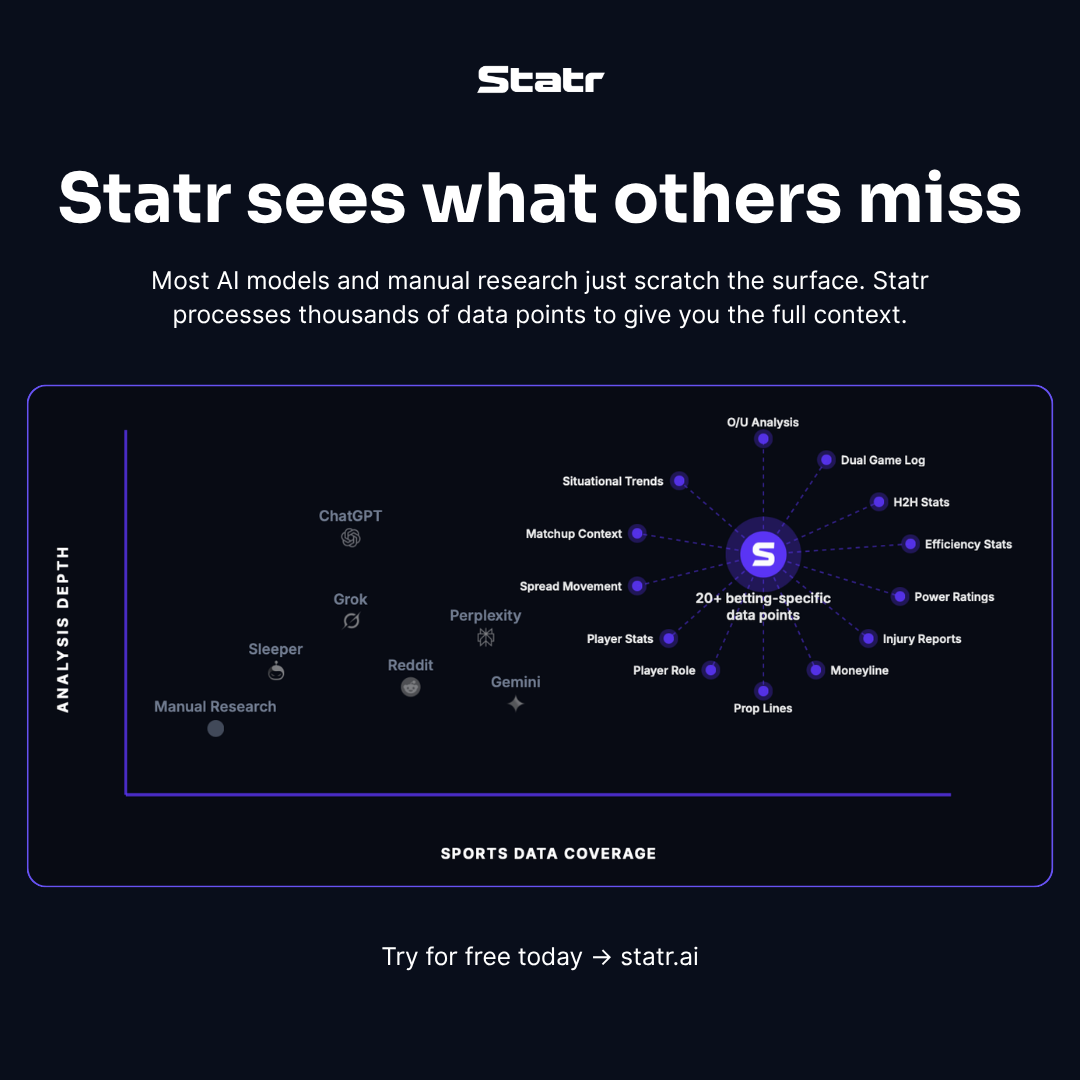
Statr processes 20+ betting-specific data layers live while general AI models rely on general web training.
Built for bettors, not for everything
ChatGPT, Claude, Gemini, and Perplexity are incredible tools, but they're generalists. They can write your resume, debug your code, and plan a vacation — so their sports output is a side feature, not the product. Statr is purpose-built for one job: checking bets. Every screen, prompt, and data source is tuned for sports analysis, which means less prompting, less guesswork, and answers that actually map to the bet you're holding.
What ChatGPT gets right (and where it stops)
ChatGPT is great at explaining concepts — ask it to define expected value or walk through the Kelly Criterion and it'll give you a clean, readable answer. The problem is the moment you ask it about a specific game tonight, a specific player prop, or a specific line move, it's working from memory, not live data. It can tell you what a steam move is, but it can't tell you whether one just happened on the game you're betting.
- ChatGPT's sports knowledge has a training cutoff — it doesn't know tonight's lineups or injuries.
- Its answers are influenced by human-written articles and opinion pieces from training data.
- You have to do the prompting work: paste stats, explain the bet, and hope it interprets it correctly.
- There's no concept of a 'bet check' — you're doing a generic chat, not a structured analysis.
Why Statr is the better tool for bet checks
Statr flips the workflow. Instead of you gathering data and feeding it to a chatbot, you upload your bet slip and Statr pulls the relevant live data itself — matchup context, player stats, line movement, injury reports, and situational trends — then translates it into a plain-English read on whether your bet looks strong or risky. You're not prompting an AI and hoping. You're getting a structured bet check built on current numbers.
The takeaway
Use ChatGPT to draft an email or learn a concept. Use Statr to check a bet. When the goal is an accurate, unbiased read on a real game with real money on the line, a purpose-built tool with live data beats a generalist chatbot every time.
Stop guessing. Statr it.
Find the next play, check the risk, and back it with stats — before you place it.