
Statr vs Perplexity: Which AI gives you a better bet check?
Perplexity is great at summarizing the web, but its sports answers come from human-written articles that carry bias. Statr pulls live stats and is built specifically for bet checks — no opinion, no stale data.
Perplexity is arguably the closest general tool to what bettors want: it searches the live web and summarizes sources with citations. That makes it better than a static-trained model for current events. But 'summarizing the web' is exactly where its weakness for bet checks shows up, because the web is full of biased, opinion-driven sports writing. Here's how Statr improves on that approach.

Statr
Purpose-built bet checks on live sports data, no biased sources, beginner-friendly chat.

Perplexity
AI search and answer engine. General-purpose, not optimized for bet checks.
Statr is built on live sports data, not stale training cutoffs
General-purpose AI models are trained on a snapshot of the internet. Their knowledge has a cutoff, and for fast-moving things like injuries, lineup changes, line movement, and last-night's box scores, a cutoff is a dealbreaker. Statr pulls from up-to-date sports data sources so the matchup context, player stats, and trends you're reading reflect what's actually happening today — not what a model memorized months ago.
Feature-by-feature comparison
Tap any row to expand the detail. A quick look at where Statr and Perplexity differ.
StatrPerplexityNo human-written articles, blogs, or opinion swaying the read
This is the biggest gap. Perplexity's answers are summaries of whatever ranks in search — articles, blogs, hot takes, and opinion pieces. For sports, that means its read is shaped by human writers who have favorites, narratives, and agendas. Statr avoids leaning on biased written sources and works from the underlying numbers, so your bet check isn't swayed by whoever published the loudest take that morning.
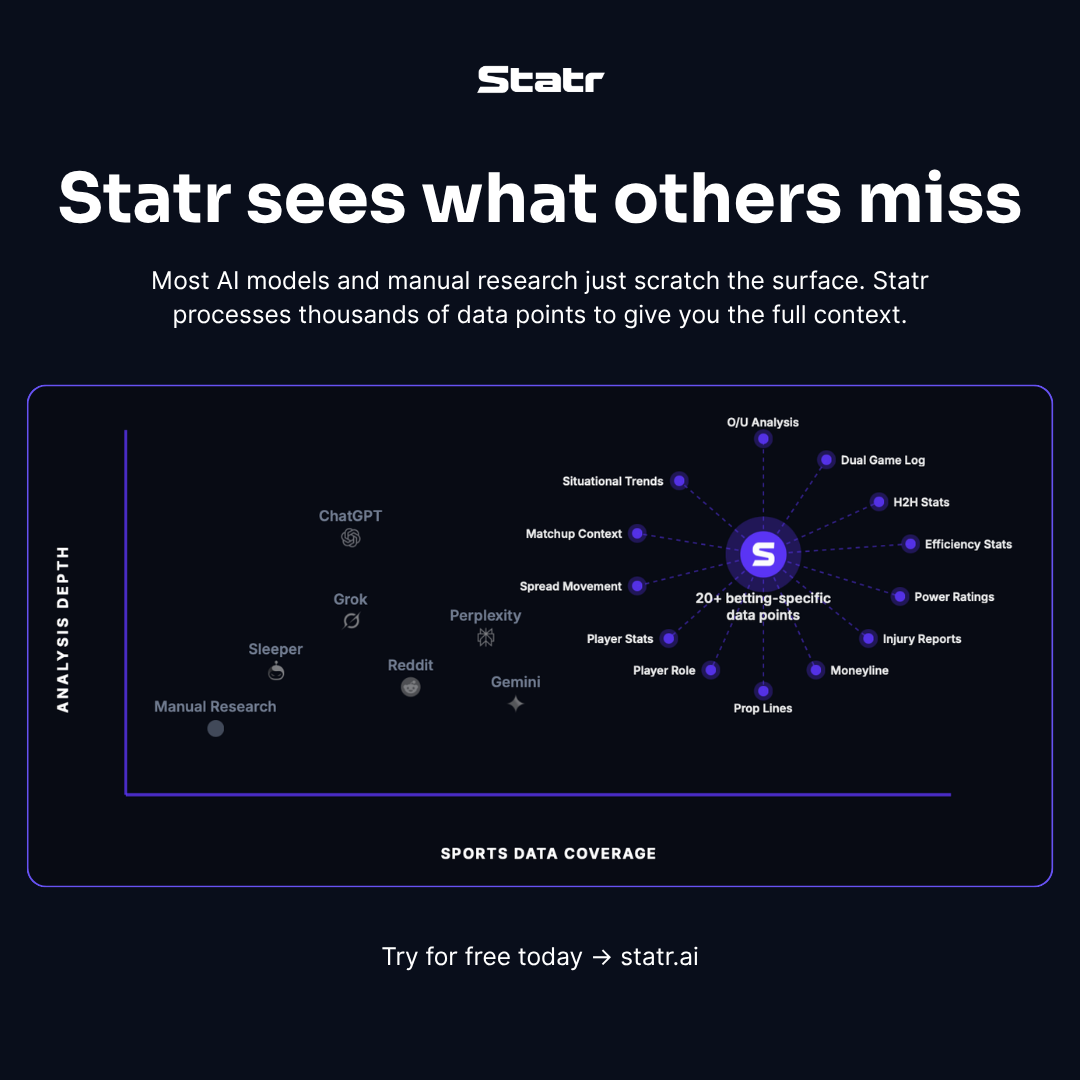
Statr processes 20+ betting-specific data layers live while general AI models rely on general web training.
Built for bettors, not for everything
ChatGPT, Claude, Gemini, and Perplexity are incredible tools, but they're generalists. They can write your resume, debug your code, and plan a vacation — so their sports output is a side feature, not the product. Statr is purpose-built for one job: checking bets. Every screen, prompt, and data source is tuned for sports analysis, which means less prompting, less guesswork, and answers that actually map to the bet you're holding.
Summaries aren't bet checks
Perplexity gives you a summary of what's out there. That's useful for research, but it's not a bet check. It won't read your bet slip, identify each leg, and tell you which ones look strong or risky and why. You still have to synthesize the summary yourself and decide what it means for your bet. Statr does that synthesis for you and returns a structured confidence read.
- Perplexity summarizes human-written sources, which carry bias and opinion.
- It doesn't read your bet slip or break down individual legs.
- There's no confidence signal — you get a summary, not a bet check.
- You still do the work of mapping the summary back to your specific wager.
Statr turns data into a decision, not a summary
Statr doesn't just surface information — it interprets it for the bet you're holding. Upload your slip and you get a plain-English read on each leg, the risks, and an overall confidence level, all grounded in current stats. That's the difference between 'here's what the internet says' and 'here's whether your bet looks strong.'
The takeaway
Perplexity is a strong research tool, but for bet checks its answers inherit the bias of human-written sources and it stops short of actually analyzing your bet. Statr is purpose-built to turn live, unbiased data into a clear read on your specific wager.
Stop guessing. Statr it.
Find the next play, check the risk, and back it with stats — before you place it.